The Solo Builder Stack: How Indie Hackers Use Claude Code to Ship Faster
How indie hackers and solo founders use Claude Code skills to go from idea to launched SaaS — scaffolding, payments, landing pages, SEO, launch, and metrics.
Shipping a SaaS product solo means wearing every hat. You write the code, the copy, the launch post, and the customer emails — often in the same day. The bottleneck isn’t talent or time; it’s context-switching between technical and non-technical work. Every time you leave engineering mode to write landing page copy, or leave marketing mode to review a Stripe webhook implementation, you pay a tax on getting back into context.
The Solo Builder Stack gives Claude a structured approach to each job in the stack — not just the engineering, but the positioning, the copy, the launch planning, and the post-launch metrics. Each skill knows what output it needs to produce and how to produce it without requiring you to reconstruct the brief from scratch each time you switch modes. The result is that the context-switching tax drops significantly, and the quality of each deliverable — the copy, the model, the architecture — is higher than it would be if you were context-switching alone.
The stack covers the full builder lifecycle: validation before you build, the engineering and product work to get something live, the marketing and distribution work to get people to the door, and the metrics and retention work that determines whether the product stays alive after launch. Most solo builders start with two or three skills that solve their immediate problem and add more as the product matures.
From idea to first paying customer
Before you build
Product Discovery frames the problem before you commit to building — user interview scripts, assumption testing, problem statement refinement, and the structured process that separates ideas worth pursuing from ones that sound good in isolation. The failure mode for solo builders isn’t usually bad execution; it’s building the wrong thing and discovering it too late. Product Discovery structures the validation process so you’re testing your assumptions before you write a line of code, not after you’ve spent two months building.
Use it when evaluating a new product idea before committing significant engineering time, when a product isn’t getting traction and you need to diagnose whether the problem is positioning or product-market fit, or when you’re deciding between two directions and want a structured framework for the comparison.
Marketing Strategy & PMM positions your product before you write a line of copy — ICP definition, value proposition, competitive differentiation, and the messaging hierarchy that makes every other marketing asset easier to produce. The positioning work you do before writing any copy determines the quality of everything downstream. A vague ICP produces vague copy that doesn’t convert. A well-defined value proposition makes the landing page, the email outreach, and the Product Hunt launch post all easier to write.
Use it when naming and positioning a new product before launch, when an existing product’s messaging has drifted and needs a structured reset, or before writing any major marketing asset where the positioning needs to be right before the copy can be right.
npx skills add alirezarezvani/claude-skills --skill marketing-skill/marketing-strategy-pmmBuilding the product
SaaS Scaffolder generates production-ready boilerplate — authentication, database setup, billing hooks, admin panel, and the project structure that gets you past zero without spending a weekend on infrastructure. The first hours of a new project are the most tempting to over-engineer: you’re making architectural decisions with incomplete information and the cost of undoing them compounds as the codebase grows. SaaS Scaffolder produces a sensible, opinionated starting structure that covers the pieces every SaaS needs and leaves the product-specific decisions for when you have enough context to make them well.
Use it at the start of a new project to generate the initial structure, or when migrating an existing project that has accumulated enough infrastructure debt that starting fresh is faster than refactoring.
Senior Fullstack Engineer provides senior engineering perspective on architecture decisions, technology choices, and the tradeoffs that matter when you’re building alone and can’t afford to rebuild later. Building solo means there’s no senior engineer to push back on a choice that will cause problems at scale, no code review to catch the pattern that works for the prototype but breaks under load. Senior Fullstack Engineer fills the role of the experienced second opinion — not just reviewing code, but asking whether the approach is right before you commit to it.
Use it when making architecture decisions that are expensive to reverse, when evaluating technology options for a new component, or when a technical choice has implications you’re not confident you’re seeing fully.
Stripe Integration Expert handles Stripe correctly — subscriptions, one-time payments, webhooks, trial logic, and the billing edge cases that catch first-time implementers off guard. Stripe’s documentation is comprehensive but the implementation details are dense: webhook signature verification, idempotency keys, subscription lifecycle events, proration handling. Getting it wrong doesn’t always produce obvious errors — it produces billing inconsistencies that surface weeks later as confused customers and mismatched revenue.
Use it when implementing billing for the first time, when adding a new pricing tier or billing model to an existing product, or when debugging a billing edge case where the webhook behaviour doesn’t match what you expected.
npx skills add alirezarezvani/claude-skills --skill product-team/saas-scaffolderGetting people to the door
Landing Page Generator builds pages that convert — headline, value proposition, feature sections, social proof placement, and the CTA structure that moves visitors toward signup. The landing page is the first impression most potential customers will get of your product, and it has to do a lot of work: establish credibility, communicate the value proposition clearly, address the most common objections, and make the next step obvious. A landing page that’s weak on any of these fails even if the product is good.
Use it when building the initial landing page for a new product, when an existing page has a conversion rate problem and you need a structured diagnosis, or when you’re running paid traffic and the landing page needs to be tighter to make the economics work.
Copywriting writes the marketing copy — homepage headlines, email subject lines, ad copy, and the persuasive writing that closes the gap between someone interested and someone signed up. Good copy is specific, direct, and focused on the reader’s problem rather than the product’s features. Most founders write copy that describes what the product does rather than what the customer gets. Copywriting corrects this by starting from the customer’s situation and working backward to the product’s value.
Use it for any marketing copy that needs to convert: homepage, product pages, email sequences, ad creative, or the launch posts that need to generate the most signal in the first 24 hours.
AI SEO builds organic traffic — keyword research, content briefs, SERP gap analysis, and the content strategy that generates search traffic for a bootstrapped product with no ad budget. SEO is the most capital-efficient distribution channel for a solo builder who can produce content but can’t outspend competitors on paid acquisition. The challenge is knowing which keywords to target, what content to produce, and how to structure it for ranking. AI SEO structures the research and brief production so the content that gets written actually has a chance of ranking.
Use it when building the content strategy for a new product, when an existing blog isn’t generating organic traffic despite consistent publishing, or when you need to prioritise which keywords are worth creating content for.
npx skills add alirezarezvani/claude-skills --skill marketing-skill/ai-seoLaunching
Launch Strategy plans the launch sequence — timing, channel selection, audience warm-up, and the announcement structure that generates maximum signal on Product Hunt, Hacker News, or your own list. A solo launch without a strategy produces a spike that decays in 48 hours and doesn’t convert to lasting growth. A launch with a strategy uses the initial spike to seed the channels that generate compounding returns: email list growth, social following, SEO signal from inbound links, and the testimonials and case studies that make future marketing easier.
Use it two to three weeks before a planned launch to build the sequence, or when launching a major new feature where the goal is to generate the same kind of signal as an initial product launch.
npx skills add alirezarezvani/claude-skills --skill marketing-skill/launch-strategyAfter launch
SaaS Metrics Coach makes sense of your numbers — MRR, churn, LTV, CAC, activation rate, and the diagnostic thinking that connects metrics to specific product or marketing actions. Metrics are only useful if they tell you what to do differently. Most solo builders track their numbers without having a clear framework for what the numbers mean or what to change when they’re off. SaaS Metrics Coach structures the analysis so each metric leads to a specific question about what’s driving it and a specific candidate action for improving it.
Use it once you have enough data to see patterns — typically after two to three months of paying customers — or when a metric has moved in an unexpected direction and you need to diagnose the cause.
Churn Prevention addresses the reasons users leave — cancel flow analysis, cohort diagnosis, onboarding gaps, and the retention interventions that actually move the needle. Churn is the most destructive force for a solo SaaS: acquiring a new customer costs more than retaining an existing one, and high churn caps the growth potential of the business regardless of how strong acquisition is. Churn Prevention structures the diagnosis — is the problem activation, product-market fit, competitive switching, or lifecycle events — so the intervention targets the actual cause.
Use it when monthly churn is higher than expected, when a specific cohort is churning at a different rate than others, or when the cancel flow data is showing a pattern that suggests a fixable problem.
npx skills add alirezarezvani/claude-skills --skill business-growth/churn-preventionHow the stack works together
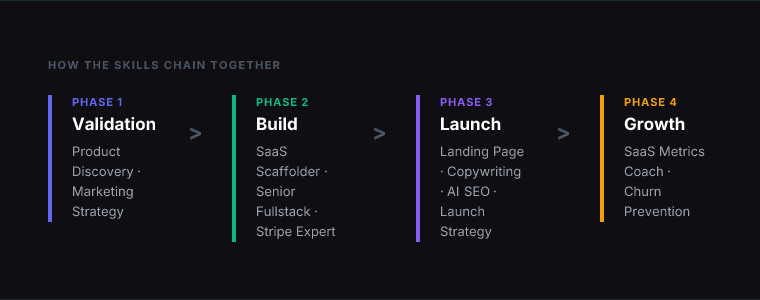
The skills map to the phases of building a solo SaaS. Here’s how they chain across the full lifecycle:
Validation phase: Use Product Discovery to test whether the problem is real before you build. Use Marketing Strategy & PMM to define the ICP and value proposition before you name the product or write the landing page.
Build phase: Use SaaS Scaffolder to generate the initial project structure. Use Senior Fullstack Engineer as your architecture review for the decisions that matter. Use Stripe Integration Expert when billing goes in — before launch, not after you’ve had your first confused customer.
Pre-launch: Use Landing Page Generator to build the page that paid and organic traffic will land on. Use Copywriting to write every piece of copy before it goes live. Use AI SEO to plan the content that will generate organic traffic in the three to six months after launch.
Launch: Use Launch Strategy to plan the sequence two to three weeks out. The launch itself is too late to start planning it.
Post-launch: Use SaaS Metrics Coach once you have data worth analyzing. Use Churn Prevention if monthly churn is higher than you expected or if a cohort is underperforming others.
Each skill triggers independently — you don’t need to use them in order or use all of them. Most solo builders start with SaaS Scaffolder and Landing Page Generator to get something live, then add the strategy and metrics skills as the product matures. The stack is designed to grow with the product, not to be installed all at once on day one.
Install the full stack
Browse all founder skills → /audiences/founders
📬 Weekly digest
Get the best new skills every Tuesday
3–5 hand-picked skills. Free forever.
More guides
April 4, 2026 · 8 min read
The CEO of Y Combinator Ships 10,000 Lines of Code a Day. Here's Exactly How.
Garry Tan runs one of the most demanding jobs in tech. He's also shipping more code than ever. gstack — his open-source Claude Code system — is how. Here's what it is and why it works.
March 25, 2026 · 7 min read
How to Create a Claude Skill (Step-by-Step Guide)
Learn how to build, test, and share your own Claude Code skills. A complete walkthrough — from blank file to installed skill — with real examples and best practices.
March 24, 2026 · 8 min read
Awesome Claude Skills: The Complete Searchable List (2026)
Every major Claude Code skills list and awesome-claude-code repository in one place — with install commands, categories, and a searchable directory for all 370+ skills.