7 Claude Skills for Finance Professionals That Handle the Repetitive Work
The best Agent Skills for finance professionals — earnings analysis, investment research, morning notes, model updates, and more. Works with Claude Code and Claude.ai.
Finance work runs on structured, repeatable outputs. Earnings notes, model updates, sector overviews, morning briefs — the format barely changes from quarter to quarter. The data changes; the document structure doesn’t. But producing that output consistently, under deadline pressure, across an entire coverage universe takes time that adds up fast.
Agent Skills give Claude a professional-grade framework for each of these deliverables. The skill handles the structure; you bring the judgment. The result is consistent, formatted output you can use directly or refine — not a freeform draft you spend 45 minutes reformatting to match your house style.
The seven skills below are built from Anthropic’s official financial services plugins, designed for equity research workflows. Whether you’re on the sell-side producing coverage documents, on the buy-side evaluating names, or in corporate finance tracking your sector, these skills compress the documentation layer so more time goes to the analysis.
The skills
1. Earnings Analysis
Earnings analysis after results drop is time-sensitive. The release comes out pre-market or after close, the sell-side notes start moving, and you need a structured view on the print — fast. Doing it manually means digging through the press release, pulling the consensus, and building the variance table before you can even start writing the narrative.
The Earnings Analysis skill gives Claude a structured framework for analysing quarterly results: revenue and EBITDA versus consensus and prior year, segment-level breakdown, key driver analysis, management guidance review, and implications for the investment thesis. The output is a formatted analysis you can use as a note, share internally, or build into a model update.
Use it immediately after results are released — paste the earnings release and relevant context, get a structured breakdown in minutes. Most useful for analysts covering multiple names who need to turn around analysis quickly across several prints in the same reporting season.
npx skills add anthropics/financial-services-plugins --skill equity-research2. Earnings Preview
The earnings preview — written one or two days before the print — sets up your view before results land. It captures the consensus, flags the key metrics to watch, identifies the variance scenarios, and gives you a framework to evaluate the actual print against. Without it, you’re reacting to results without a prior position.
The Earnings Preview skill gives Claude a structured approach to producing preview notes: consensus estimates with historical context, the key watchpoints for this particular quarter, scenario analysis for upside and downside prints, and the factors that are most likely to drive a surprise versus consensus. The output is a structured note you can send before results or use as your internal preparation.
Use it one or two days before a scheduled earnings release to prepare your view and have a note ready to send immediately after the print drops. Especially useful during peak reporting season when you’re covering multiple names in the same week.
npx skills add anthropics/financial-services-plugins --skill equity-research3. Morning Note
A daily morning note is one of the most consistent commitments in research — and one of the most time-consuming to produce at quality every day. Scanning overnight developments, synthesising the macro backdrop, filtering to what’s relevant for your coverage universe, and writing it up in a format clients can consume quickly all takes longer than it should before markets open.
The Morning Note skill gives Claude a structured approach to producing daily morning research notes: overnight market moves, macro developments, company-specific news in the coverage universe, and the key items to watch during the session. Consistent format, every day — so readers know where to find what they need without reading the whole note.
Use it as part of your morning workflow — feed it the overnight context, get a structured first draft you can edit and send. Over time, the consistent format becomes its own value: clients learn the structure and read it faster.
npx skills add anthropics/financial-services-plugins --skill equity-research4. Initiating Coverage
An initiating coverage note is the most comprehensive document in the research workflow. Investment thesis, business model overview, financial model assumptions, valuation analysis (DCF and comps), risk factors, and price target — it’s a multi-week project that involves every part of your analytical toolkit. The documentation layer is extensive even when the analysis is done.
The Initiating Coverage skill gives Claude a structured framework for building the full initiation note: investment thesis in clear, defensible terms, business and competitive landscape summary, financial model assumptions, valuation methodology and sensitivity analysis, key risk factors with mitigants, and price target with return to target. The skill handles the structure so you can focus on getting the thesis right.
Use it when starting coverage on a new name — input your research, model outputs, and thesis, get a structured draft that follows the initiation format. Most useful as a drafting scaffold rather than a one-shot output: feed it your analysis progressively and refine.
npx skills add anthropics/financial-services-plugins --skill equity-research5. Model Update
Model updates after events — earnings, guidance revisions, M&A announcements — are one of the most tedious parts of research production. The changes to estimates are usually straightforward. The change log, variance explanation, and updated price target narrative take disproportionate time relative to the actual analytical work involved.
The Model Update skill gives Claude a structured approach to documenting model changes: what changed and why, the impact on key estimates (revenue, EBITDA, EPS), the revised price target with updated return to target, and the change narrative you can include in a client note or internal record. It handles the documentation so the analysis stays front and centre.
Use it immediately after updating your model — input the key changes and the updated outputs, get a structured change log and narrative ready to include in a note or client communication. Especially valuable when you’re updating multiple models in a single day.
npx skills add anthropics/financial-services-plugins --skill equity-research6. Idea Generation
The earliest stage of investment research — generating and screening new ideas — is often the least structured. Conversations, screens, sector thematic, channel checks: good ideas can come from anywhere, but evaluating them quickly against a consistent framework is what separates the ones worth pursuing from the ones worth filing.
The Idea Generation skill gives Claude a structured framework for generating and screening investment ideas: identifying potential mispricings, applying structured screening criteria, evaluating the quality of the variant view relative to consensus, and assessing the risk/reward profile. The output is a structured assessment of whether an idea merits further work, not a buy recommendation.
Use it when starting a new screening process, when pressure-testing a new idea before committing research time, or when you want a structured second opinion on an early-stage thesis before developing it further.
npx skills add anthropics/financial-services-plugins --skill equity-research7. Catalyst Calendar
Managing a coverage universe means tracking a high volume of upcoming events — earnings dates, analyst days, regulatory decisions, macro data releases, M&A events. Keeping the calendar organised and the watchlist current is operationally important and easy to let slip when you’re heads-down on a note.
The Catalyst Calendar skill gives Claude a structured approach to tracking and organising upcoming catalysts for a coverage universe: earnings dates, conference schedules, expected regulatory events, and company-specific milestones. The output is a structured calendar you can use for internal planning, client communication, or prioritising research effort.
Use it to maintain a structured catalyst view across your coverage, to prepare a client-facing catalyst summary for the coming weeks, or to prioritise where to focus your attention during a busy reporting period.
npx skills add anthropics/financial-services-plugins --skill equity-researchHow these skills chain together
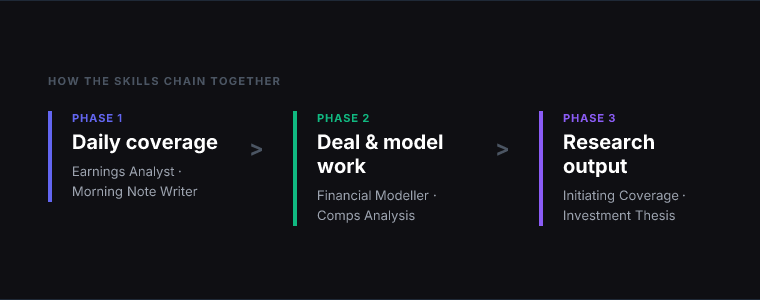
Here’s how these skills flow through a typical quarter for an equity research analyst:
Between earnings: Use Idea Generation to screen new names or pressure-test emerging ideas. Use Catalyst Calendar to keep the coverage universe organised and identify upcoming events worth previewing.
Before earnings: Use Earnings Preview two days before the print — set up the consensus, flag the watchpoints, and have a structured view before results land.
Day of earnings: Use Earnings Analysis immediately after results drop — paste the release, get a structured breakdown in minutes, and turn around a note while the print is still fresh.
Model updates: Use Model Update after any earnings, guidance revision, or event that changes your estimates — keep the change log current and the client narrative ready.
New coverage: Use Initiating Coverage when starting on a new name — use it as the structural scaffold for the full initiation note.
Daily: Use Morning Note as part of the pre-market routine — consistent format, every session.
Want the full set by role?
Four stacks cover the main finance verticals:
- The Equity Research Stack — idea generation, coverage initiation, model updates, earnings, and morning notes
- The Investment Banking Stack — teasers, CIMs, pitch decks, buyer lists, merger models, and deal execution
- The Private Equity Deal Stack — deal sourcing through IC memo, portfolio monitoring, and value creation
- The Wealth Management Stack — financial plans, portfolio rebalancing, tax-loss harvesting, and client reports
How to install
Browse all finance skills → /audiences/finance
📬 Weekly digest
Get the best new skills every Tuesday
3–5 hand-picked skills. Free forever.
More guides
April 4, 2026 · 8 min read
The CEO of Y Combinator Ships 10,000 Lines of Code a Day. Here's Exactly How.
Garry Tan runs one of the most demanding jobs in tech. He's also shipping more code than ever. gstack — his open-source Claude Code system — is how. Here's what it is and why it works.
March 25, 2026 · 7 min read
How to Create a Claude Skill (Step-by-Step Guide)
Learn how to build, test, and share your own Claude Code skills. A complete walkthrough — from blank file to installed skill — with real examples and best practices.
March 24, 2026 · 8 min read
Awesome Claude Skills: The Complete Searchable List (2026)
Every major Claude Code skills list and awesome-claude-code repository in one place — with install commands, categories, and a searchable directory for all 370+ skills.