7 Claude Skills for DevOps Engineers That Cut the Toil
The best Agent Skills for DevOps and platform engineers — CI/CD pipelines, observability, incident response, secrets management, infrastructure as code, and more. Works with Claude Code.
DevOps work has two kinds of tasks. The first requires judgment: deciding the right deployment strategy for a service with a complex dependency graph, choosing how to handle secrets across a multi-cloud environment, designing the observability layer for a distributed system that needs to be debugged under pressure. The second kind is the surrounding work — writing runbooks, configuring pipelines, drafting postmortems, documenting procedures — that needs to be done well but doesn’t require the same level of expertise to produce.
Agent Skills are built for the second category. They give Claude a structured, expert-level approach to the documentation and configuration work that surrounds infrastructure decisions, so engineers can spend more time on the architecture and less time on the paperwork.
The seven skills below cover the DevOps workflow from pipeline design through incident response and migration planning. They work best with Claude Code, where direct file access and shell execution make the infrastructure workflows actually executable rather than theoretical.
The skills
1. Senior DevOps Engineer
Infrastructure decisions made without a structured review often produce systems that work until they don’t scale — pipelines that became bottlenecks, Kubernetes configurations that made sense for the initial workload but not for the one six months later, IaC patterns that accumulated technical debt quietly until a migration became necessary.
The Senior DevOps Engineer skill gives Claude a structured senior DevOps perspective on infrastructure decisions: pipeline design trade-offs, deployment strategy selection (blue-green, canary, rolling), Kubernetes architecture review, IaC pattern recommendations, and the engineering trade-offs that determine whether a platform stays maintainable as it scales.
Use it when designing new infrastructure, when reviewing architecture choices before building them, or when you want a second opinion on a platform decision before committing to an approach. Most useful as a structured thinking partner on decisions that are reversible in principle but expensive to reverse in practice.
npx skills add alirezarezvani/claude-skills --skill engineering-team/senior-devops2. CI/CD Pipeline Builder
Building a production CI/CD pipeline from scratch means making dozens of small decisions: which stages run in parallel, how to handle test failures, where the deployment gates are, what the rollback trigger is, how to handle environment-specific configuration. Getting it wrong produces a pipeline that’s slow, brittle, or both.
The CI/CD Pipeline Builder skill gives Claude a structured approach to building production CI/CD pipelines for GitHub Actions, GitLab CI, and CircleCI: build stages designed for parallelism, test integration with the right failure semantics, deployment automation with configurable rollback triggers, environment promotion logic, and the pipeline patterns that give teams fast and reliable delivery without sacrificing safety.
Trigger it with the tools you’re using and the deployment target — get a production-ready pipeline configuration back. Most useful when starting a new pipeline from scratch, when migrating a pipeline from one CI system to another, or when an existing pipeline has accumulated enough cruft that it’s faster to rebuild with a clean design.
npx skills add alirezarezvani/claude-skills --skill engineering/ci-cd-pipeline-builder3. Observability Designer
An observability gap only becomes visible when something goes wrong and you can’t answer the first question: is this affecting users? Designing the observability layer before production means choosing the right metrics, defining SLIs and SLOs that map to real user experience, and building the alerting thresholds that fire on real problems rather than noise.
The Observability Designer skill gives Claude a structured approach to designing the observability layer for a distributed system: metrics selection and instrumentation strategy with OpenTelemetry, log structure and retention policy, distributed tracing configuration, SLI and SLO definition for each service tier, alerting threshold design, and Prometheus/Grafana dashboard layout for on-call engineers.
Use it when instrumenting a new service or system before it goes to production, when auditing an existing system’s observability gaps after an incident where the missing signal was the problem, or when defining SLOs for a service that’s about to go into a formal SLA.
npx skills add alirezarezvani/claude-skills --skill engineering/observability-designer4. Runbook Generator
Runbooks are the most consistently underdocumented part of platform operations. They get written once — if at all — and then decay as the system changes. Engineers who wrote the original procedure leave. The runbook describes a step that no longer applies. A new engineer follows it during an incident and makes things worse.
The Runbook Generator skill gives Claude a structured approach to writing operational runbooks: step-by-step procedures for deployments, incident recovery, and maintenance tasks with explicit rollback steps, verification checks at each stage, escalation criteria, and the context that makes the runbook usable by someone who didn’t write it.
Use it to document any process you’ve run manually more than twice — the threshold at which the documentation overhead pays off. Also useful for converting informal tribal knowledge into structured runbooks before a team member who holds that knowledge leaves.
npx skills add alirezarezvani/claude-skills --skill engineering/runbook-generator5. Incident Commander
Incidents are high-pressure situations where communication structure matters most and is hardest to maintain. Who’s working on what, what’s the current hypothesis, what’s been tried, who needs to be updated — without a structured process, these questions get answered inconsistently and things fall through.
The Incident Commander skill gives Claude a structured approach to leading incident response from detection to resolution: coordinating the response team, maintaining the incident timeline and current status, structuring war room communication so responders can focus on the problem rather than the communication overhead, and drafting the postmortem document immediately after resolution while the timeline is fresh.
Trigger it when an incident is declared — use it to structure the response from the first minute. Most valuable for teams without a formal incident response playbook and for situations where the incident commander is an engineer who’s also trying to diagnose the problem rather than a dedicated role.
npx skills add alirezarezvani/claude-skills --skill engineering-team/incident-commander6. Environment & Secrets Manager
Secrets management is one of the most consistently underdesigned parts of infrastructure. Credentials hardcoded in environment files, rotation policies that exist in documentation but not in practice, CI/CD pipelines with access to secrets they don’t need — the attack surface grows quietly as the codebase grows.
The Environment & Secrets Manager skill gives Claude a structured approach to designing secure secrets management across environments: vault configuration and access policy design, secret rotation policy implementation, CI/CD pipeline integration that limits secret scope to the stages that need it, environment variable hygiene across local, staging, and production, and the patterns that prevent credential sprawl as the team and the infrastructure scale.
Use it when setting up secrets management for a new service or environment, when auditing how credentials are currently handled across an existing system, or when a security review has flagged secrets management as a gap.
npx skills add alirezarezvani/claude-skills --skill engineering/env-secrets-manager7. Migration Architect
Migrations have a consistent failure pattern: they’re planned as if they’re straightforward, and the edge cases surface mid-execution. Database migrations that fail on a table that wasn’t in the schema diagram. Framework upgrades that break an undocumented integration. Cloud provider transitions that reveal load patterns the new provider handles differently.
The Migration Architect skill gives Claude a structured approach to planning and executing code and system migrations: migration strategy selection (big bang vs. incremental), dependency mapping, rollback trigger definition, the execution sequence that minimises downtime, and the validation checks that confirm the migration completed correctly before the old system is decommissioned.
Use it when planning any migration with a non-trivial blast radius if it goes wrong: database migrations, framework major version upgrades, cloud provider transitions, and any architectural change that can’t be rolled back instantly.
npx skills add alirezarezvani/claude-skills --skill engineering/migration-architectHow these skills chain together
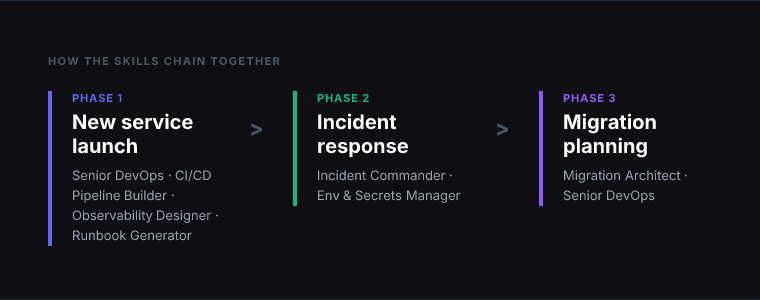
Here’s how these skills map to two common DevOps scenarios: launching a new service and managing an incident.
Launching a new service: Use Senior DevOps Engineer during architecture review to pressure-test the infrastructure design. Use CI/CD Pipeline Builder to build the deployment pipeline before the service goes to staging. Use Observability Designer to define the SLIs, SLOs, and alerting before the service is in production. Use Runbook Generator to document the deployment, rollback, and common maintenance procedures before the first on-call rotation.
Managing an incident: Use Incident Commander when the incident is declared — structure the response from minute one. Use Environment & Secrets Manager if the incident involves a credential leak or misuse. Use Runbook Generator after the postmortem to document the resolution procedure for the next occurrence. Use Observability Designer to fill the observability gaps the incident revealed.
Planning a migration: Use Migration Architect to design the migration strategy. Use Senior DevOps Engineer to review the architecture implications. Use Runbook Generator to document the migration procedure and rollback steps.
Want the full set?
The DevOps & Platform Stack bundles CI/CD pipeline design, infrastructure observability, secrets management, and security engineering into one curated starter set.
→ View the DevOps & Platform Stack
How to install
Browse all DevOps skills → /audiences/devops
📬 Weekly digest
Get the best new skills every Tuesday
3–5 hand-picked skills. Free forever.
More guides
April 4, 2026 · 8 min read
The CEO of Y Combinator Ships 10,000 Lines of Code a Day. Here's Exactly How.
Garry Tan runs one of the most demanding jobs in tech. He's also shipping more code than ever. gstack — his open-source Claude Code system — is how. Here's what it is and why it works.
March 25, 2026 · 7 min read
How to Create a Claude Skill (Step-by-Step Guide)
Learn how to build, test, and share your own Claude Code skills. A complete walkthrough — from blank file to installed skill — with real examples and best practices.
March 24, 2026 · 8 min read
Awesome Claude Skills: The Complete Searchable List (2026)
Every major Claude Code skills list and awesome-claude-code repository in one place — with install commands, categories, and a searchable directory for all 370+ skills.