7 Claude Code Skills for Developers That Actually Speed You Up
The best Agent Skills for developers — API design review, agent workflow design, test suite building, analytics, and more. Install with one command into Claude Code.
Most developers use Claude Code for one-off questions — fix this bug, explain this error, suggest a refactor. That’s useful, but it’s not what Claude Code was built for.
Agent Skills change the dynamic. Each skill is a structured set of instructions that gives Claude a consistent, expert-level approach to one specific task. Install it once, and Claude handles that task the same way every time — your preferences baked in, not re-explained from scratch on every session.
The skills below cover the parts of engineering that rarely get enough attention: API design quality, test coverage, experiment methodology, analytics instrumentation, and multi-agent system architecture. They’re not IDE autocomplete. They’re workflow tools for the engineering decisions and deliverables that happen around the code — the work that’s always important but never urgent enough to do properly.
The skills
1. API Design Reviewer
Bad API design is expensive to fix after the fact. Inconsistent endpoint naming, missing versioning strategy, unclear error response formats — these feel like minor decisions until they’re breaking backward compatibility six months later and you’re writing migration guides for three different client teams.
The API Design Reviewer skill gives Claude a structured framework for reviewing REST and GraphQL API designs against industry standards: naming conventions, HTTP method usage, status code consistency, pagination patterns, authentication flow, versioning strategy, and developer experience considerations.
Use it before shipping a new endpoint to catch issues while they’re cheap to fix, during an API design session with stakeholders to structure the conversation, or when onboarding a new engineer who needs to get up to speed on your API conventions. The output is a structured review you can take into a design discussion or commit directly to an ADR.
npx skills add alirezarezvani/claude-skills --skill engineering/api-design-reviewer2. API Test Suite Builder
Writing test suites from scratch is the kind of work that gets deprioritized until a regression slips through. The pattern is always the same: you know you need contract tests, integration tests, and regression coverage — you just don’t want to write the boilerplate again.
The API Test Suite Builder skill structures Claude’s approach to building comprehensive API test suites — contract tests, integration tests, load tests, and automated regression for REST and GraphQL APIs. It covers test case generation, mocking strategy, edge case identification, error scenario coverage, and test data setup.
Use it when starting coverage on a new API, when bringing an existing API under test for the first time, or when a regression surfaces and you need to add coverage fast without spending an afternoon thinking about test architecture.
npx skills add alirezarezvani/claude-skills --skill engineering/api-test-suite-builder3. Agent Designer
Building multi-agent systems without a clear architecture is a fast way to end up with overlapping responsibilities, undefined failure modes, and coordination logic scattered across files that nobody fully understands.
The Agent Designer skill gives Claude a structured framework for designing multi-agent AI systems — defining agent roles, communication protocols, tool use patterns, coordination strategies, and failure recovery approaches. It helps you work through the full agent architecture before writing a line of code: who the agents are, what they’re responsible for, how they hand off work, and what happens when something fails.
Use it at the start of an agentic project when you’re deciding how to divide responsibilities between agents, or when an existing system has grown complex enough that the coordination model needs to be made explicit rather than implied.
npx skills add alirezarezvani/claude-skills --skill engineering/agent-designer4. Agent Workflow Designer
Agent architecture and agent workflow are related but different problems. Architecture answers who the agents are and what they own. Workflow answers what they do, in what sequence, with what handoffs and checkpoints.
The Agent Workflow Designer skill structures Claude’s approach to mapping agentic workflows: task sequencing, tool use patterns, human-in-the-loop checkpoints, retry logic, parallel execution paths, and reliability optimisation. It’s particularly useful when the workflow spans multiple systems or requires handoffs between agents and humans at specific decision points.
Pairs naturally with the Agent Designer skill — use Agent Designer to define the architecture, then Agent Workflow Designer to map the execution model.
npx skills add alirezarezvani/claude-skills --skill engineering/agent-workflow-designer5. Analytics Tracking Setup
Most developers implement analytics tracking once, under time pressure, and never fully understand what they set up. GA4 has a steep learning curve, event naming conventions drift over time, and tracking gaps don’t surface until someone asks a question you can’t answer and you realise the data was never collected.
The Analytics Tracking Setup skill gives Claude a structured approach to implementing and auditing analytics — GA4 event schema, Google Tag Manager configuration, conversion tracking setup, UTM parameter standards, and measurement plan documentation. It handles the setup and the documentation, so the next developer on the team can understand what’s being tracked, why, and how to extend it.
Use it when spinning up analytics on a new project, when auditing existing tracking for gaps or inconsistencies, or when handing off analytics ownership to a new team member and you want the documentation to actually be useful.
npx skills add alirezarezvani/claude-skills --skill marketing-skill/analytics-tracking6. A/B Test Setup
Most A/B tests fail not because the hypothesis was wrong, but because the test wasn’t designed correctly. Underpowered sample sizes, multiple primary metrics without corrections, starting analysis before the planned end date — the most common mistakes are methodological, not technical, and they’re easy to avoid with the right structure upfront.
The A/B Test Setup skill gives Claude a structured approach to experiment design: writing a clear hypothesis, calculating the required sample size for statistical power, designing variants, defining the primary and guardrail metrics, and documenting the results interpretation framework before the test runs.
Use it before you build the test, not after. A well-designed experiment running for two weeks produces cleaner conclusions than a badly-designed one running for six that leaves the team arguing about what the data actually means.
npx skills add alirezarezvani/claude-skills --skill marketing-skill/ab-test-setup7. Agile Product Owner
Most developers who find themselves in a product owner role — leading a team, running a sprint, writing user stories — learned it on the job. The result is usually a backlog that’s a mix of well-written stories and vague tickets that mean different things to different people, a sprint planning meeting that runs long, and a retro where everyone agrees things need to be more structured.
The Agile Product Owner skill gives Claude a structured approach to product ownership: INVEST-compliant user story writing, acceptance criteria definition, backlog prioritisation frameworks, sprint capacity planning, and epic breakdown. It’s not a PM replacement — it’s a structured assistant for developers who are playing a product role without dedicated PM support.
Most useful for tech leads and senior engineers running their own sprints, early-stage teams without a dedicated product person, or any developer who’s been told “you’re the product owner now” without much guidance on what that actually means week to week.
npx skills add alirezarezvani/claude-skills --skill product-team/agile-product-ownerHow these skills chain together
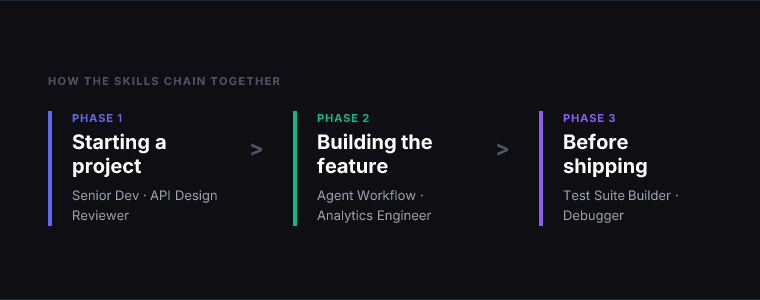
Here’s how several of these skills fit into a single engineering scenario — shipping a new API endpoint that will be experimentally rolled out.
Before implementation: Use API Design Reviewer on the endpoint spec. Catch naming inconsistencies, missing versioning, and unclear error responses while the cost of changing them is still zero.
During implementation: Use Agent Designer and Agent Workflow Designer if the endpoint is part of a larger agentic system. Map the architecture before writing orchestration logic.
After implementation: Use API Test Suite Builder to generate contract and integration tests against the finalized spec. Use Analytics Tracking Setup to instrument the endpoint if usage data matters for the rollout decision.
If it’s a feature experiment: Use A/B Test Setup to design the experiment methodology before you start collecting data.
None of these skills replace engineering judgment. They structure the work so the judgment gets applied to the right problems instead of being spent on boilerplate and setup.
Want a curated starter set?
There are four stacks built specifically for engineering teams:
- The Senior Engineer Stack — architecture, code review, testing, DevOps, security, and observability
- The AI Engineer Stack — RAG pipelines, agent architectures, MCP servers, and MLOps
- The DevOps & Platform Stack — CI/CD, observability, secrets management, and platform engineering
- The Security Engineering Stack — threat modelling, zero-trust architecture, ISO 27001, and GDPR
How to install
npx skills add <repo> --skill <path>One command, runs in your project directory. Claude Code picks it up immediately.
Browse all developer skills → /audiences/developers
📬 Weekly digest
Get the best new skills every Tuesday
3–5 hand-picked skills. Free forever.
More guides
April 4, 2026 · 8 min read
The CEO of Y Combinator Ships 10,000 Lines of Code a Day. Here's Exactly How.
Garry Tan runs one of the most demanding jobs in tech. He's also shipping more code than ever. gstack — his open-source Claude Code system — is how. Here's what it is and why it works.
March 25, 2026 · 7 min read
How to Create a Claude Skill (Step-by-Step Guide)
Learn how to build, test, and share your own Claude Code skills. A complete walkthrough — from blank file to installed skill — with real examples and best practices.
March 24, 2026 · 8 min read
Awesome Claude Skills: The Complete Searchable List (2026)
Every major Claude Code skills list and awesome-claude-code repository in one place — with install commands, categories, and a searchable directory for all 370+ skills.